
There was a time when meditation was viewed as something separate from “real life.”
Something reserved for retreats, spiritual practice, or people trying to escape the pressures of the world.
Today, that perception is changing.
Increasingly, business leaders, entrepreneurs, creatives, and professionals are discovering that meditation is not about withdrawing from life — it is about learning how to engage with life more clearly.
Because clarity changes everything.
The Modern Mind Is Overstimulated
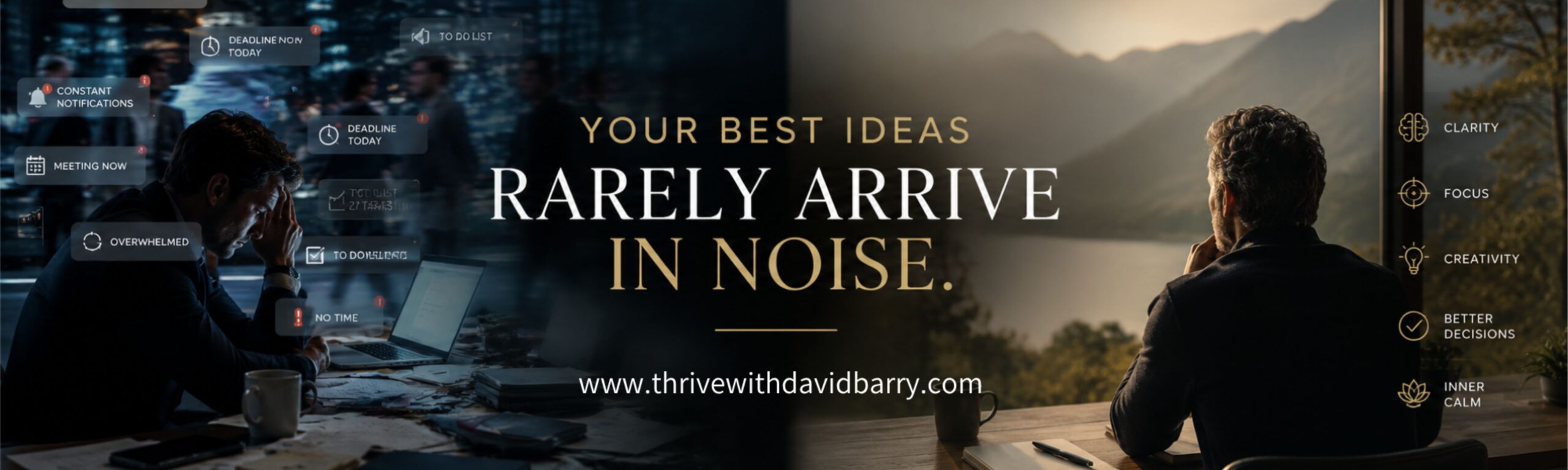
Most people live in a near-constant state of mental noise.
Notifications. Deadlines. Meetings. Scrolling. Decision fatigue. Pressure to perform. Pressure to keep up.
Over time, this creates a kind of internal static.
You can still function. You can still achieve. You can still appear successful.
But internally, the mind becomes crowded.
And when the mind is crowded, creativity struggles to emerge.
Many people assume they need more motivation, more productivity systems, or more information.
What they often need is space.
Meditation creates that space.
Meditation Is Not About “Stopping Thought”
One of the biggest misconceptions about meditation is that it requires an empty mind.
It does not.
Meditation is not about forcing silence. It is about developing awareness.
The practice simply allows you to observe the mind rather than being completely consumed by it.
Over time, something interesting begins to happen:
You become less reactive. Less emotionally scattered. Less mentally overwhelmed.
And in that quieter internal environment, insight begins to surface naturally.
Not forced. Not manufactured. Not overthought.
Simply recognised.
Creativity Requires Mental Space
Some of the best ideas do not arrive when we are trying aggressively to “figure things out.”
They emerge in moments of stillness.
During a walk. In silence. After reflection. While sitting quietly without distraction.
Why?
Because creativity does not thrive under constant internal pressure.
The mind needs room to connect ideas in a deeper way.
Meditation helps create the conditions where that becomes possible.
This is why many entrepreneurs, executives, writers, athletes, and innovators have integrated reflective practices into their routines.
Not because it makes them passive. But because it improves clarity, intuition, and perspective.
And perspective is one of the most valuable assets any leader can develop.
Better Decisions Come From Greater Awareness
In business, poor decisions are often made from emotional overload rather than lack of intelligence.
Stress narrows perception.
Fear creates urgency.
Mental exhaustion reduces discernment.
Meditation helps interrupt that cycle.
It creates a pause between stimulus and response.
That pause matters.
Because within it, we often make better decisions. We communicate more effectively. We lead with greater emotional intelligence. We respond instead of reacting.
This does not only impact business performance.
It impacts relationships, wellbeing, health, and overall quality of life.
Stillness Is Not Weakness
There is a misconception that slowing down means losing momentum.
In reality, the opposite is often true.
People who never pause eventually lose connection with themselves.
And when that happens, it becomes difficult to know whether they are building a life that is truly aligned — or simply staying busy.
Meditation is not about becoming disconnected from ambition.
It is about ensuring ambition remains conscious.
Grounded.
Purposeful.
A Different Kind of Success
Success without clarity can still feel empty.
Achievement without inner alignment often leads to burnout.
Many professionals eventually reach a point where external progress no longer compensates for internal exhaustion.
Meditation offers something increasingly rare in modern life:
The opportunity to reconnect with yourself beneath the noise.
And from that place, people often discover renewed creativity, clearer direction, better emotional balance, and a deeper sense of purpose.
Not because meditation “fixes” life.
But because it allows people to experience life with greater awareness.
And awareness changes how we think, work, create, and lead.